How to Grow Your Small Business Online in India: A Practical 2026 Playbook
A field guide to website, WhatsApp, SEO, and UPI, built for how India actually shops online.
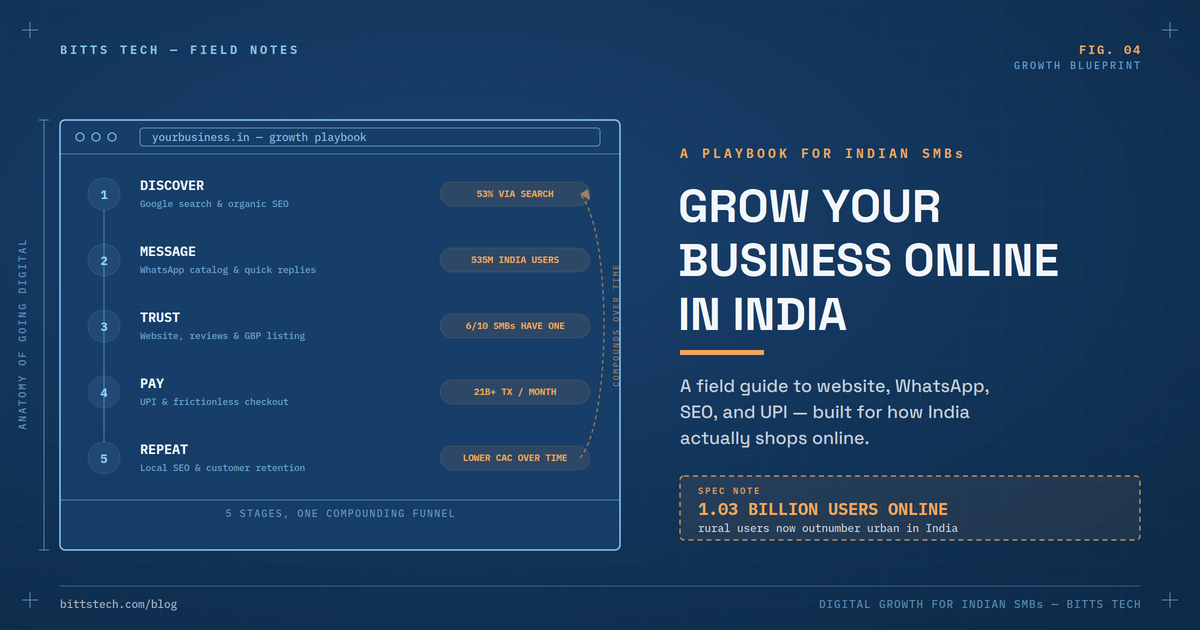
India now has roughly 1.03 billion internet users — a 70% penetration rate — and for the first time in the country's digital history, rural internet users outnumber urban ones. Add to that over 500 million people using WhatsApp daily and a payments system processing more than 21 billion UPI transactions a month, and the infrastructure question that used to hold small businesses back is essentially answered: the customers are online, the payment rails are frictionless, and the cost of reaching them keeps falling.
What hasn't caught up is how most small businesses actually use that infrastructure. Roughly 6 in 10 small businesses in India now have a website or online store — which means 4 in 10 still don't, and a large share of the ones that do treat it as a one-time setup rather than an active growth channel. This guide lays out a practical, India-specific playbook: what actually moves the needle, in what order, and why — written from the perspective of a studio that builds this infrastructure for small businesses every day.
Why Now Is the Moment for Indian Small Businesses to Go Digital
A few shifts have converged at the same time, and together they change the calculation for small businesses that have been on the fence about investing seriously online.
The audience has arrived, including outside metros. India's internet base has crossed a symbolic threshold: rural users now outnumber urban ones, driven by cheaper smartphones and falling data costs. Businesses that assumed their customer base was "too local" or "too offline" for digital investment are increasingly wrong about that — the next wave of Indian internet growth is coming from exactly the kind of towns and customer segments small businesses already serve.
Payments are no longer the friction point. UPI processed roughly 228 billion transactions in 2025 alone, growing from 172 billion the year before, and now accounts for the vast majority of India's retail digital payments. For a small business, this means the historical objection — "my customers don't trust online payment" — has largely dissolved. The infrastructure to collect payment instantly, with no card machine and near-zero transaction friction, already exists in your customer's phone.
Customers expect to find you before they call you. This mirrors a pattern true everywhere, but it's intensifying fast in India specifically as search and WhatsApp become the default first stop before any purchase decision, local or otherwise.
Language is no longer a barrier to reach. Roughly 68% of Indian internet users now prefer content in their native language, and non-English-speaking internet users have long outnumbered English speakers in the country. A business publishing only in English is, by definition, optimizing for a shrinking share of its potential online audience.
The Five Pillars of Growing Online in India
1. A Website That Actually Converts
This is still the foundation everything else points back to — your ads, your Google Business Profile, your WhatsApp catalog link, all eventually lead someone to a website (or should). The core requirements don't differ from global best practice: fast load times, mobile-first design (the majority of Indian web traffic is mobile), clear contact information, and a specific value proposition rather than a generic "welcome to our company" homepage. We covered this in detail in our piece on why websites are important — the short version is that a website functions as a 24/7 credibility check, and most Indian small businesses are still losing customers at exactly this step before any marketing spend even enters the picture.
2. SEO Built for How India Actually Searches
Search behavior in India has its own shape: heavily mobile, increasingly voice-driven, and split across English and regional languages depending on the audience. Organic search remains the largest traffic driver for most businesses globally, and that holds in India too — but with an added layer most generic SEO advice misses: local intent and language match matter more here, not less. A business serving a Hindi-speaking customer base in Lucknow competing only in English-language SEO is leaving most of its addressable local search volume untouched. Our deeper guide on why SEO is important covers the mechanics; the India-specific addition is to treat regional-language content and voice-friendly long-tail phrases as core keyword targets, not an afterthought.
3. WhatsApp as a Primary Sales and Support Channel
This is the pillar most global playbooks skip, and it may be the single highest-leverage channel for Indian small businesses specifically. India is WhatsApp's single largest market in the world, with over 500 million users, and roughly 80% of small and medium businesses in India already use WhatsApp to communicate with and acquire customers. Customers in India don't just tolerate this — many actively prefer it: a meaningful share of online shoppers say they engage with a brand on WhatsApp before completing a purchase. A WhatsApp Business catalog, quick-reply automation for common questions, and order updates sent directly through the app can function as a lightweight storefront and support desk in a market where customers are already spending hours a week inside the app regardless.
4. UPI and Frictionless Digital Payments
If a customer has decided to buy and your checkout process introduces friction — a card form, a redirect, a slow gateway — you lose a share of that decision before it completes. UPI's scale in India (over 21 billion transactions processed monthly, with adoption still climbing toward an estimated 90% of retail digital payment volume) means customers expect a UPI option by default, not as a bonus. For a small business, this is one of the cheapest improvements available: integrating UPI checkout removes one of the last remaining points of purchase friction, and it's a change most customers will simply expect rather than need convincing of.
5. Local Visibility and Google Business Profile
For any business serving customers in a specific city or region, this is frequently the highest-return, lowest-cost investment on this list. A complete Google Business Profile, accurate business hours, a steady stream of genuine reviews, and consistent business information across the web let a small, well-optimized local business compete directly with far larger, better-funded national competitors for the exact searches happening in its own neighborhood. This pillar compounds particularly well in India's tier-2 and tier-3 cities, where local search behavior is growing fastest and competition for visibility is often thinner than in metro markets.
A Practical Roadmap: Where to Start
These five pillars aren't meant to be tackled simultaneously — sequencing matters, both for budget efficiency and for results compounding properly.
1. Fix the website foundation first. Speed, mobile usability, clear contact information, and a real value proposition. This underpins every other channel below it. 2. Set up WhatsApp Business with a catalog, even a simple one. This is typically the fastest, cheapest channel to activate and often the first place a referred customer will look for you. 3. Claim and complete your Google Business Profile, and start actively collecting reviews. For local businesses, this alone often produces visible results faster than any other single step. 4. Build SEO content in the language(s) your customers actually use, not just English — including location-specific pages if you serve a defined geographic area. 5. Add UPI and remove checkout friction, if you sell directly online. 6. Only then, layer in paid ads. Running ads to a website or WhatsApp funnel that isn't ready yet simply makes every click more expensive — we've written a full pre-launch checklist on exactly this if you're at this stage.
Common Mistakes Indian Small Businesses Make Going Digital
- Building a website once and never returning to it. A static, outdated site signals neglect to both customers and search engines, and it stops compounding the moment it stops being maintained.
- Treating WhatsApp as personal-only. Many small businesses still run customer communication through a personal number with no catalog, no automation, and no separation from personal messages — losing the efficiency and professionalism a proper Business account provides.
- Publishing only in English in markets where the majority of the addressable audience prefers regional-language content, particularly outside metro cities.
- Skipping Google Business Profile despite serving a clearly local customer base — one of the lowest-cost, highest-return digital investments available, left untouched.
- Running ads before the funnel is ready. Paid traffic amplifies whatever experience already exists; sent to a slow, generic, or English-only page, it simply makes failure more expensive rather than fixing it.
How This Comes Together
None of these five pillars works in isolation, and that's the actual point. A customer's real journey in India increasingly looks like this: discover you through a Google search or a referral, message you on WhatsApp with a quick question, check your website or reviews to confirm you're legitimate, pay instantly through UPI, and — if the experience was good — come back without needing to be found again. Each pillar reinforces the next, and skipping one creates a leak the others can't fully compensate for. A business that gets all five working together doesn't just get more traffic; it gets a lower cost of acquiring each customer over time, because trust, visibility, and convenience are compounding in the same direction rather than fighting each other.
Frequently Asked Questions
Do I need an English website, a regional-language website, or both? If a meaningful share of your customers prefer a regional language — which is true for most businesses outside large metro audiences — build core pages in both. Even partial regional-language coverage (a homepage and key service pages) tends to outperform English-only sites for local search visibility and trust.
Is WhatsApp enough, or do I still need a separate website? WhatsApp is an excellent sales and support channel, but it isn't a replacement for a website. A website is what shows up in search results, builds long-term SEO value, and gives you a destination you fully control — WhatsApp works best as the next step after a customer has already discovered you.
How much does it typically cost to get a small business properly online in India? Costs vary widely by scope, but a functional, mobile-optimized website with basic SEO and WhatsApp Business integration is achievable on a modest budget for most small businesses — the bigger cost, in practice, is usually the ongoing maintenance and content work that businesses skip after the initial setup.
Should I sell directly through my own website, or list on marketplaces like Amazon and Flipkart too? These aren't mutually exclusive, and most growing businesses eventually do both. Marketplaces offer faster initial reach and built-in trust; your own website and WhatsApp presence build a customer relationship you fully own, with no marketplace commission and no algorithm dependency.
Do I need GST or Udyam registration before going online? Requirements depend on your business structure, turnover, and what platforms you plan to sell on — several marketplaces and payment gateways require GST registration above certain thresholds. This is worth confirming with a tax professional or chartered accountant specific to your situation rather than treating it as a blanket rule.
Final Thoughts
The infrastructure argument for going digital in India isn't theoretical anymore — the users, the payment rails, and the search behavior are already there, including in markets small businesses have historically considered too local to bother with. What's left is execution: a website that actually converts, a WhatsApp presence that's treated as a real channel rather than a personal number, visibility in the language your customers actually use, and a checkout that matches how they already pay everywhere else. Done in the right order, these five pillars don't just add traffic — they compound into a lower, more sustainable cost of growth over time.