Why SEO Is Important: How It Drives Long-Term Business Growth
A field guide to what SEO does, why it compounds, and where to focus first.
Every day, Google processes more than 8.5 billion searches. Somewhere in that volume are people searching for exactly what your business offers — a product, a service, an answer to a problem you solve. The question that determines whether that search turns into a customer is simple: when they search, does your business show up?
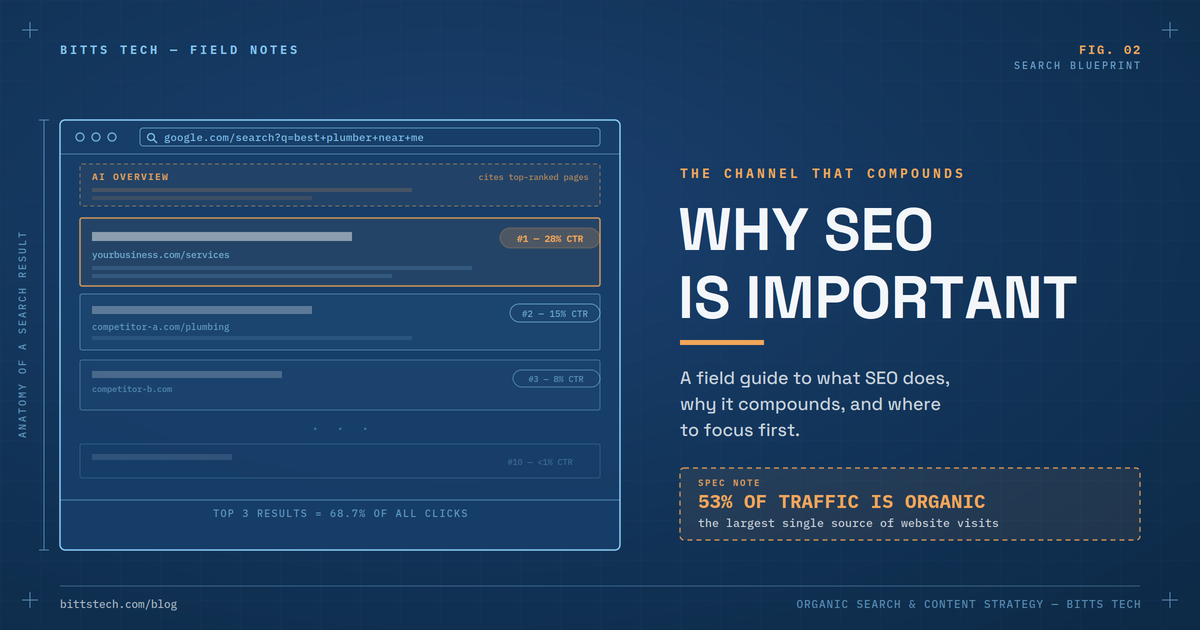
That's what SEO (Search Engine Optimization) is for. It's not a technical afterthought or a one-time project — it's the discipline of making sure your business is visible at the exact moment someone is looking for it. Organic search currently drives roughly 53% of all website traffic, making it the single largest traffic source for most businesses, ahead of social media, email, and direct visits combined. In this guide, we'll cover why SEO is important for business growth specifically, what's actually necessary to do it well, and where to focus your time and budget for the best return.
What Is SEO, and What Does It Actually Do for a Business?
SEO is the practice of improving a website so that search engines can find it, understand it, and rank it favorably for relevant searches. But the more useful way to think about it is as a growth mechanism with a specific shape: unlike most marketing channels, SEO compounds.
A paid ad stops generating traffic the moment you stop paying for it. A social post has a lifespan measured in hours. A well-optimized page, by contrast, can keep generating traffic and leads for years after it's published, and that traffic tends to get cheaper over time rather than more expensive. That compounding effect is the core economic reason SEO is important — it converts a marketing expense into something closer to a long-term asset.
Why SEO Is Important: The Business Case, Backed by Data
1. Organic Search Is Still the Largest Source of Website Traffic
Despite the rise of social media and paid advertising, organic search remains the dominant channel through which people discover businesses online, accounting for roughly 53% of total website traffic across industries. Google alone holds close to 90% of global search market share, meaning that for most businesses, ranking well on Google specifically is the highest-leverage visibility decision they can make.
2. A Small Number of Positions Capture Almost All the Clicks
Where you rank matters enormously. Research analyzing real search behavior found that the top three organic results capture more than two-thirds (68.7%) of all clicks on a typical Google results page. The number one organic result alone tends to receive more clicks than positions three through ten combined, and substantially more clicks than the top paid ad in the same search. Beyond the first page, click-through drops to a fraction of a percent. In practice, this means SEO isn't really about "being findable" in a general sense — it's about competing for a small number of positions that capture nearly all the value.
3. SEO Delivers Stronger Long-Term ROI Than Paid Advertising
Multiple industry analyses comparing the two channels consistently find that organic search converts visitors at roughly double the rate of paid search — around 2.4% for SEO traffic compared to roughly 1.3% for PPC traffic — while also producing a meaningfully lower cost per lead over time. The pattern most businesses see is predictable: PPC delivers a lower cost-per-lead in year one, since campaigns can launch in weeks, but by year two or three, a well-executed SEO strategy typically overtakes it on cost efficiency, often by a wide margin, because rankings continue to generate traffic without proportional ongoing spend. Most analyses put that crossover point at roughly twelve to eighteen months of consistent investment.
4. SEO Is Now the Foundation Beneath AI-Generated Search Results Too
This is the development most relevant to 2026 specifically. As AI Overviews and AI-powered search experiences become more common, there's a temptation to assume SEO matters less. The data says the opposite. AI Overviews are generated primarily by citing pages that already rank well organically — meaning your traditional SEO performance directly determines whether you're included in the AI-generated answer at all. Pages that fail basic technical SEO checks are invisible not just to Google's normal index, but to its AI features as well. If anything, the bar has gotten higher: businesses now need strong topical authority and clean structured data to be eligible for both kinds of visibility, not just one.
It's worth being direct about the tradeoff here too: when an AI Overview appears above the organic results, click-through rates for the top-ranking organic pages do tend to drop, in some studies by as much as half. That's a real shift in how search traffic flows, but it's an argument for adapting SEO strategy, not abandoning it — the businesses still being cited and clicked are the ones with the strongest existing organic authority.
5. Local SEO Lets Small Businesses Outrank National Competitors Nearby
Roughly 46% of all Google searches have local intent, and 76% of mobile searches with local intent lead to a visit to a physical business within 24 hours. This is one of the most underused growth levers for small and mid-sized businesses: local SEO doesn't require competing nationally. A well-optimized Google Business Profile and consistent local signals can outrank far larger, better-funded competitors for searches happening in your immediate market.
6. SEO Lowers Customer Acquisition Cost as It Matures
Because PPC costs scale linearly with traffic — more visitors always means more spend — while SEO costs are largely front-loaded, the cost per lead from organic search tends to decline the longer a strategy runs, even as paid channels see rising costs from increased competition. This is why nearly half of marketers in industry surveys cite SEO as their most profitable marketing channel overall, even though it takes longer to show results than paid campaigns.
7. Strong SEO Performance Is Also a Trust Signal
Ranking well isn't purely about traffic volume — it also functions as third-party validation. Search engines reward sites that demonstrate genuine expertise, authority, and trustworthiness (often shortened to E-E-A-T), and users have learned, consciously or not, to treat high organic rankings as a proxy for credibility. A business that consistently shows up for relevant searches reads as established; one that's nowhere to be found reads as either new, small, or untrustworthy — regardless of how good the underlying business actually is.
What's Necessary to Have Good SEO? The Core Pillars
Knowing why SEO is important doesn't tell you how to actually get the results. Effective SEO rests on a small number of pillars, and skipping any one of them creates a ceiling on what the others can achieve.
Technical SEO
This is the foundation everything else depends on. If a search engine can't properly crawl, render, and index your site, nothing else you do matters. Core requirements include a fast-loading, mobile-first site (Google ranks primarily based on the mobile version of your pages), a valid XML sitemap, clean and crawlable URL structures, an SSL certificate (HTTPS), no broken links or redirect chains, and structured data (schema markup) that helps search engines and AI systems understand exactly what a page is about.
On-Page SEO
This covers everything on the page itself: targeting the right keywords based on actual search intent rather than guesswork, writing descriptive title tags and meta descriptions, using a logical heading structure (one H1, organized H2s and H3s), internal linking between related pages, and content that genuinely answers the question the searcher came with. Google's algorithm weighs over 200 ranking factors, but content quality and relevance to search intent consistently rank among the most influential.
Off-Page SEO and Backlinks
Search engines treat links from other reputable websites as a vote of confidence. Pages ranking in the top positions tend to have significantly more high-quality backlinks than lower-ranking pages, and the quality of those links matters far more than the quantity. Earning links through genuine digital PR, partnerships, guest content, and being a source worth citing outperforms volume-based link building every time.
Content Strategy
SEO and content marketing are inseparable. Over 65% of business websites maintain a blog specifically because fresh, optimized content gives search engines new material to index and lets a business build topical authority — depth of coverage on a subject — over time. Long-tail, specific queries make up the majority of all searches, and businesses that consistently publish content targeting those queries tend to see compounding organic growth rather than a single traffic spike.
Local SEO
For any business serving a physical area, this is often the highest-return SEO investment available: a complete, accurate Google Business Profile, consistent name/address/phone (NAP) information across the web, location-specific pages where relevant, and a steady stream of genuine customer reviews.
User Experience Signals
Search engines also factor in how real users behave on your site — bounce rate, time on page, and return visits all feed back into rankings, which means SEO and good web design are not separate disciplines. A technically perfect page that nobody wants to stay on still underperforms.
How to Improve SEO: Where to Focus First
Most businesses don't fail at SEO because they're missing one clever trick — they fail because they tackle these pillars in the wrong order or abandon the effort before compounding growth kicks in. A practical priority sequence looks like this:
1. Fix the technical foundation first. Site speed, mobile usability, and crawlability issues cap your ceiling no matter how good your content is. This is also the fastest set of fixes to make. 2. Map content to real search intent, not assumptions. Keyword research should answer what your actual customers are typing into Google, including the specific long-tail phrases that convert better than broad, competitive terms. 3. Build topical depth consistently. A handful of one-off blog posts rarely moves the needle; a steady cadence of content covering a topic area thoroughly is what builds the authority search engines and AI systems both reward. 4. Earn backlinks deliberately, through real relationships, partnerships, and content worth linking to — not bulk-purchased links, which can actively harm rankings. 5. Claim and optimize local listings if you serve a physical area; this is frequently the fastest path to visible results for small businesses. 6. Add structured data (schema) to your most important pages, which increases eligibility for rich results and AI-generated answers. 7. Track and iterate. Search Console and analytics data should drive ongoing decisions — what's ranking, what's getting clicks, and where the gaps are — rather than treating SEO as a one-time setup.
Common SEO Mistakes That Stall Growth
- Treating SEO as a one-time project. Optimizing a site once and never returning to it is one of the most common reasons businesses see rankings plateau or decline.
- Chasing keywords with no commercial relevance, which brings traffic that never converts.
- Ignoring technical health while focusing entirely on content, leaving crawl errors and slow load times capping the results.
- Buying low-quality backlinks, which can trigger search engine penalties rather than improving authority.
- Inconsistent publishing, which signals a stale or abandoned site to both users and search engines.
- No measurement framework, making it impossible to know which efforts are actually working.
How SEO Translates Into Business Growth
It's worth connecting the dots explicitly. Better rankings mean more qualified traffic, since organic visitors are actively searching for what you offer rather than being interrupted by an ad. More qualified traffic at a lower, declining cost per lead means a lower overall customer acquisition cost over time. A business with strong organic visibility also becomes less dependent on, and less vulnerable to, rising ad costs — and 87% of industries saw paid search costs increase in 2025 alone. And because ranking well functions as a credibility signal in its own right, the same SEO investment that drives traffic also reinforces the trust that converts that traffic into customers. Put together, SEO isn't simply a traffic channel — it's one of the few growth levers that gets cheaper and more valuable the longer a business invests in it.
Frequently Asked Questions
How long does SEO take to show results? Most businesses start seeing measurable movement within three to six months, with the cost-per-lead crossover point versus paid advertising typically arriving between twelve and eighteen months of consistent effort.
Is SEO still worth it with AI Overviews changing search results? Yes — AI Overviews are generated by citing pages that already rank well organically, so strong SEO is what makes a business eligible for that visibility in the first place, not a reason to skip it.
What matters more: content or backlinks? Both, but they serve different roles. Content determines whether you can rank and whether AI systems consider you an authoritative source; backlinks determine how much trust search engines extend to that content. Neither compensates fully for a serious gap in the other.
Do small businesses really need SEO, or is it just for large companies? Local SEO specifically tends to favor smaller, well-optimized businesses, since a complete Google Business Profile and strong local signals can outrank much larger national competitors for searches happening in your immediate area.
Should I choose SEO or paid ads? They're complementary rather than competing. PPC is the better tool for fast, predictable short-term traffic; SEO is the better tool for sustainable, compounding long-term growth. Most well-run marketing strategies use both, weighted toward organic over time.
Final Thoughts
SEO is slower than paid advertising and less immediately visible than a redesigned website — which is exactly why so many businesses underinvest in it. But the data is consistent: organic search remains the largest traffic source available, the top few ranking positions capture nearly all the value, and a business that builds real search visibility ends up with lower acquisition costs, more qualified traffic, and a credibility signal that paid channels can't replicate. The businesses that treat SEO as ongoing infrastructure, rather than a project with an end date, are the ones still compounding their growth years later.