Why Websites Are Important: The Complete Guide for Modern Businesses
A field guide to what a website does, why it matters, and what yours actually needs.
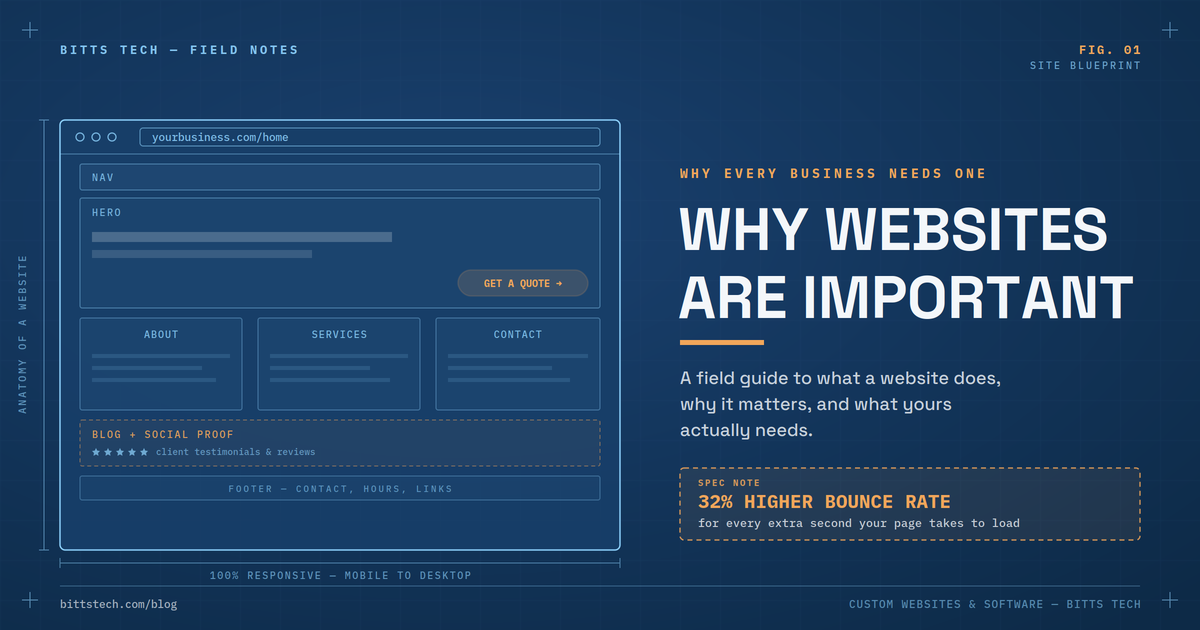
If you have ever wondered whether your business actually needs a website, the data answers that question clearly. As of 2026, roughly 83% of small businesses in the U.S. operate one, and 39% of businesses plan to increase their investment in web development this year as competition for customer attention intensifies. Yet a meaningful share of businesses still treat their website as an afterthought — a digital business card thrown together once and never updated again.
That gap between "having a website" and "having a website that works" is where most of the opportunity sits. In this guide, we'll break down why websites are important from a business and technical standpoint, what a website actually does for you, what it should contain, and how to avoid the mistakes that quietly cost businesses customers every day.
What Does a Website Actually Do?
Before getting into the "why," it helps to be precise about the "what." A website is not just an online brochure. A properly built site performs several functions simultaneously:
- It acts as your 24/7 storefront. Unlike a physical location or a sales team, your website never closes. It answers questions, shows your offerings, and can capture leads while you sleep.
- It establishes credibility before any human interaction happens. Most people will look you up online before calling, emailing, or visiting in person.
- It is a data engine. A website lets you track exactly how people find you, what they look at, and where they drop off — information no offline channel can give you at the same resolution.
- It is the foundation that every other marketing channel points to. Social media posts, ads, email campaigns, and search results all eventually funnel traffic to your website. Without one, every other marketing effort has nowhere to land.
- It scales without scaling your headcount. A single well-designed page can serve thousands of visitors simultaneously — something no individual salesperson or support agent can do.
Why Websites Are Important: Reasons Backed by Data
1. Websites Build Trust and Credibility Instantly
Research from Stanford University's Persuasive Technology Lab, based on studies involving thousands of participants, found that a large share of users judge a company's credibility primarily by the visual design and usability of its website rather than its actual content. Separate industry research backs this up: 94% of people cite poor web design as a reason they distrusted or rejected a website outright, and 38% say they will stop engaging with a site altogether if the layout feels unattractive or outdated.
In practical terms, this means your website is often doing the work of a first handshake. A clean, professional, fast-loading site builds the same kind of instant credibility a well-kept storefront or a tidy office does — and a cluttered, slow, or outdated one undermines trust before a visitor reads a single word of your copy.
2. Most Customers Research Online Before They Ever Contact You
Around 81% of consumers research a business online before using its services, and a similar majority say they expect to find essential information — hours, pricing, services, reviews — without having to call and ask. If a prospective customer searches for your business and finds nothing, or finds a broken or barebones site, they typically move to the next option rather than reaching out to ask questions.
This is one of the clearest, most measurable reasons why websites are important: the buying decision is frequently made, or at least narrowed down, before any direct conversation takes place.
3. Mobile Traffic Now Dominates — and Most Sites Aren't Ready
Mobile devices account for over half of all global website traffic, and that share continues to climb every year. At the same time, more than half of small business websites are not properly optimized for mobile devices. That's a significant gap: businesses are losing the majority traffic source because their site wasn't built with it in mind.
A mobile-unfriendly site doesn't just look bad on a phone — it actively damages your search visibility too, since Google primarily uses the mobile version of your site to determine rankings (a practice known as mobile-first indexing).
4. Page Speed Has a Direct, Measurable Effect on Revenue
This is one of the most extensively studied areas in web performance, and the numbers are striking. Google's research, based on an analysis of millions of mobile landing pages, found that as load time increases from one second to three seconds, the probability of a visitor bouncing rises by 32%. By the time load time reaches ten seconds, that probability jumps by 123%. Separately, 53% of mobile visits are abandoned outright if a page takes longer than three seconds to load.
The financial impact compounds from there. A joint study by Google and Deloitte found that even fractions of a second in load-time improvement can meaningfully shift conversion rates and revenue. Amazon has famously calculated that every 100 milliseconds of added latency costs it roughly 1% in sales. For a business doing meaningful online revenue, that's not a rounding error — it's real money left on the table because of technical performance, not marketing.
5. Websites Outperform Social Media Alone
Many small businesses lean on social media instead of building a proper website, assuming it covers the same ground. The data suggests this is a costly assumption: businesses that maintain both a website and a social media presence generate roughly twice the revenue of those relying on social media alone. Social platforms are rented land — you don't control the algorithm, the design, or whether the platform remains relevant. A website is an owned asset that compounds in value over time, particularly through SEO.
6. Organic Search Visibility Compounds Over Time
Unlike paid ads, which stop generating traffic the moment you stop paying, a well-optimized website continues to attract visitors through organic search long after the content is published. Over 65% of business websites now include a blog specifically because it improves search visibility and gives search engines fresh, relevant content to index and rank. This is also why content marketing and SEO are treated as long-term compounding investments rather than one-time costs.
7. A Website Is the One Channel You Fully Own and Control
Every other digital channel — social platforms, marketplaces, directory listings — operates under someone else's rules, design constraints, and algorithm changes. Your website is the one place where your brand, messaging, pricing, and customer experience are entirely in your hands. That ownership matters more as digital competition increases.
What Should a Website Contain? The Essential Elements Checklist
Knowing why websites are important is only half the picture — the other half is making sure yours is actually built to perform. Based on conversion research and best practice, here is what an effective business website needs.
Homepage Essentials
- A clear, specific value proposition above the fold — what you do, who it's for, and why it matters — visible within seconds of landing on the page
- A primary call-to-action (CTA) that's impossible to miss (Contact Us, Book a Call, Get a Quote, Shop Now)
- Fast load time (under 3 seconds is the generally accepted benchmark)
- Mobile-responsive layout that works cleanly on small screens
An About Us Page
This page is more important than most businesses realize. 52% of visitors say it's the first page they look for, and visitors who view the About page tend to spend over 22% more than those who don't. It should cover who you are, your story, your team, and why a visitor should trust you — not just a generic mission statement.
Products or Services Pages
Clear, specific descriptions of what you offer, with pricing information where possible (ambiguity here is a common reason visitors leave without contacting you).
Visible Contact Information
44% of visitors will leave a website if they can't find contact details. Phone number, email, physical address (if relevant), and a contact form should all be easy to locate — not buried three clicks deep.
Social Proof
Testimonials, reviews, case studies, client logos, or ratings. People trust other people's experiences more than a company's claims about itself.
A Blog or Resource Section
Beyond SEO value, a blog demonstrates expertise, answers common customer questions before they're asked, and gives you something genuinely useful to share through email and social channels.
Technical SEO Foundations
- SSL certificate (HTTPS) — both a trust signal and a Google ranking factor
- Clean, descriptive URL structures (avoid long strings of random characters or parameters)
- Proper heading hierarchy (one H1 per page, logical H2/H3 structure)
- Image alt text and compressed image files for faster load times
- Schema markup where applicable, to improve how your pages appear in search results
- An XML sitemap submitted to Google Search Console
Clear Calls-to-Action Throughout
Every page should answer the question "what should the visitor do next?" — whether that's calling, booking, buying, or subscribing.
Common Website Mistakes That Quietly Cost Businesses Customers
Even well-intentioned businesses make recurring mistakes that undercut their site's effectiveness:
- No clear CTA on the homepage. Visitors who don't know what to do next simply leave.
- Slow load times, often from unoptimized images or excessive third-party scripts.
- Poor mobile experience, despite mobile traffic now exceeding desktop in most industries.
- Outdated or stale content — over a third of small business sites are rarely updated, which signals neglect to both visitors and search engines.
- Missing or hard-to-find contact information.
- No SEO foundation, meaning the site is effectively invisible in search results no matter how well it's designed.
- Broken links and dead pages, which damage both user trust and search rankings.
How to Build a Website That Actually Works
A website built purely to "exist" rarely performs. A website built with conversion, speed, mobile usability, and search visibility in mind from the start tends to outperform a redesign bolted on later. If you're building a new site or auditing an existing one, prioritize in this order: technical performance and mobile responsiveness first, clear messaging and CTAs second, then content and SEO to compound results over time.
Frequently Asked Questions
Why is a website important for a small business specifically? Small businesses compete directly with larger players for the same online searches. A well-built website levels that playing field by giving a small business the same credibility, visibility, and 24/7 availability that larger competitors have.
How fast should my website load? Under 3 seconds is the generally accepted threshold. Beyond that, bounce rates rise sharply, and Google's Core Web Vitals also factor load speed into search rankings.
Do I really need a blog on my business website? Not strictly, but it's one of the most effective ways to build long-term organic search traffic, since blog content gives search engines fresh material to index and gives potential customers answers to questions they're already searching for.
Is a website still necessary if I'm active on social media? Yes. Businesses with both a website and a social media presence generate significantly more revenue than those relying on social media alone, and a website is the one digital asset you fully control.
What's the single most important page on a website? There isn't one universal answer, but the homepage, About page, and contact information consistently rank as the pages visitors look for first and abandon a site over most quickly when missing or poorly built.
Final Thoughts
A website isn't a one-time expense — it's ongoing infrastructure for how your business is discovered, evaluated, and trusted. The data is consistent across every major study referenced here: design and speed affect trust within seconds, most buying decisions begin with online research, and businesses that invest in a properly built, well-maintained website consistently outperform those that don't.
If your current site is outdated, slow, or missing the essentials covered above, that's usually a sign it's costing you customers you never see — the ones who land on your page and quietly leave before ever reaching out.